- What Is the Difference Between a Capsule Filter and a Cartridge Filter?
- What Is a Capsule Filter?
- What Is a Cartridge Filter?
- Capsule Filter vs Cartridge Filter: Quick Comparison
- Difference in Housing Design
- Difference in Flow Capacity
- Difference in Filtration Area
- Difference in Hold-Up Volume
- Difference in Installation
- Difference in Contamination Risk
- Difference in Cleaning Requirements
- Difference in Sterilization
- Difference in Integrity Testing
- Difference in Pressure Capability
- Difference in Cost
- Difference in Waste Generation
- Typical Applications of Capsule Filters
- Typical Applications of Cartridge Filters
- Can Capsule and Cartridge Filters Use the Same Media?
- Capsule Filter vs Cartridge Filter for Sterile Filtration
- Capsule Filter vs Cartridge Filter for Water Treatment
- How to Choose Between a Capsule Filter and a Cartridge Filter
- Common Selection Mistakes
- Frequently Asked Questions
- Conclusion
What Is the Difference Between a Capsule Filter and a Cartridge Filter?
The main difference between a capsule filter and a cartridge filter is the way the filtration element is installed and contained.
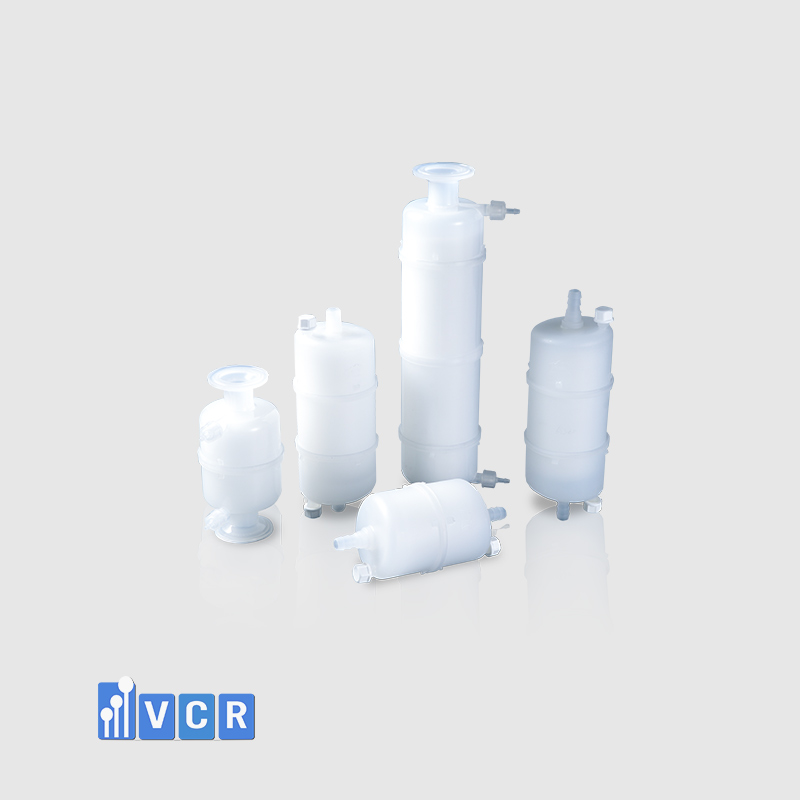
A capsule filter is a complete, self-contained filtration unit. The filter media is permanently enclosed inside a plastic housing with integrated inlet and outlet connections. The entire capsule is normally replaced after use.
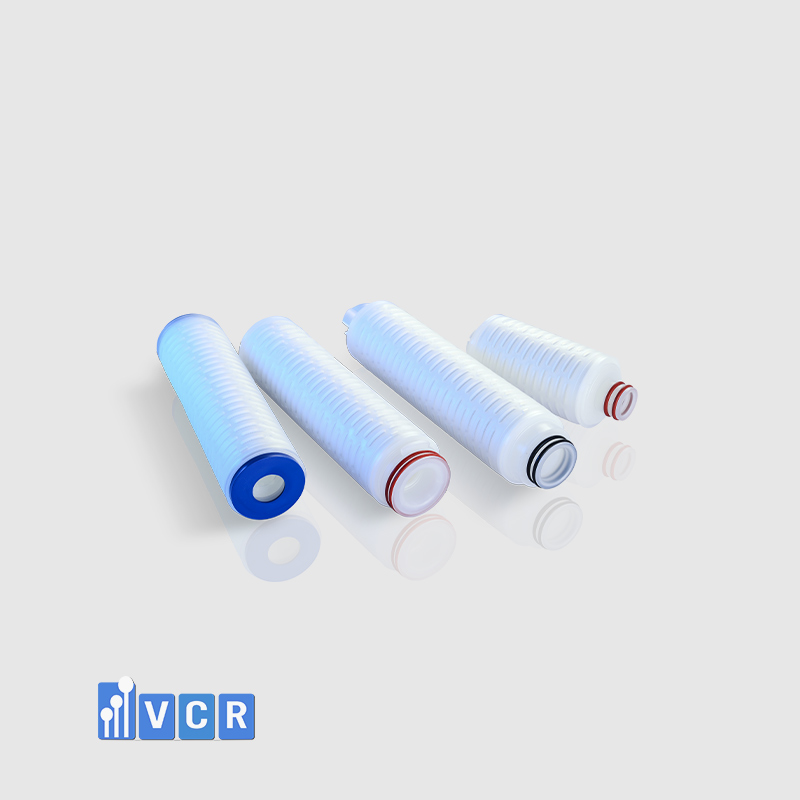
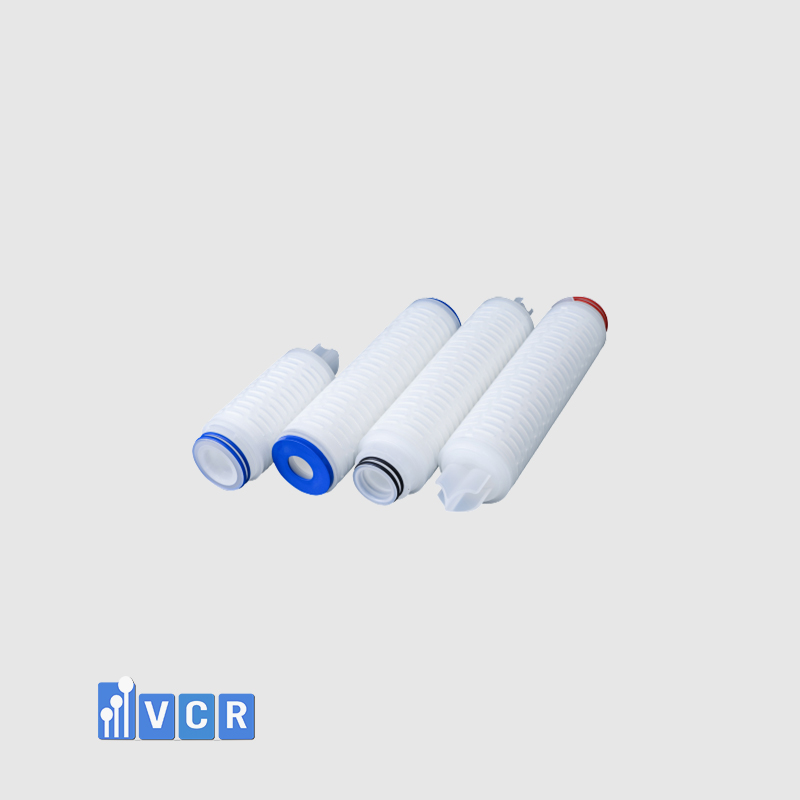
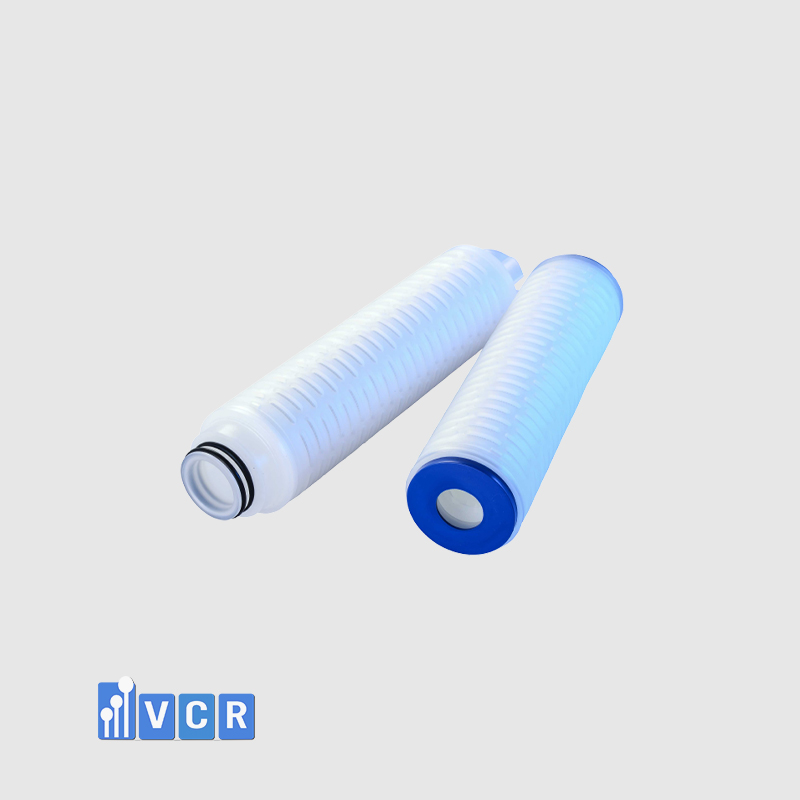
A cartridge filter is a replaceable filtration element that must be installed inside a separate reusable filter housing. When the cartridge reaches its service limit, the housing is opened, the used cartridge is removed, and a new cartridge is installed.
Capsule filters are generally preferred for small batches, laboratory systems, pilot production, sterile processing, point-of-use filtration and applications requiring a closed disposable flow path.
Cartridge filters are generally preferred for continuous production, higher flow rates, larger batch volumes and industrial systems where the reusable housing helps reduce the filtration cost per unit of processed liquid.
The filter media inside both products may be similar. A capsule filter can contain the same type of pleated membrane or depth-filter media used in a conventional cartridge. The most important difference is therefore not always the filtration medium, but the format, housing arrangement, connection method and intended scale of use.
What Is a Capsule Filter?
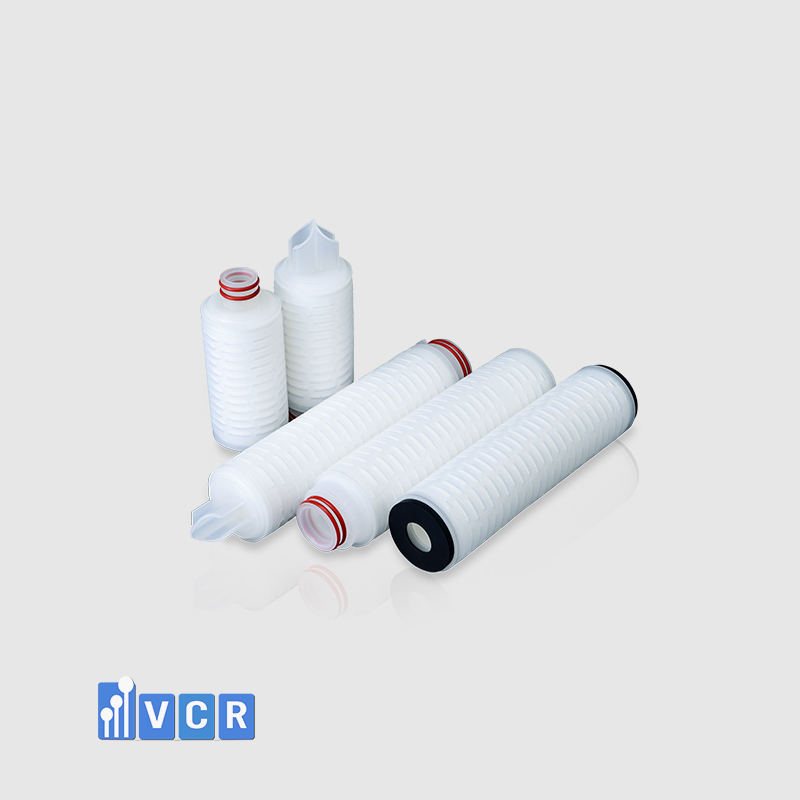
A capsule filter is a compact filtration assembly in which the filter element and outer housing are permanently integrated.
The capsule normally includes filter media, support layers, an internal core, an external plastic shell, end seals and process connections. The assembly is manufactured as a closed unit and is not intended to be opened by the operator.
Capsule filters may contain pleated membrane media, pleated polypropylene media, glass-fiber media, depth-filter media or multilayer combinations. Common membrane materials include polyethersulfone, polytetrafluoroethylene, polyvinylidene fluoride, nylon and polypropylene.
The inlet and outlet may use hose barbs, sanitary connections, threaded ports, stepped adapters or other small-scale process fittings. Vent and drain connections may also be incorporated into the housing.
Because the filter media is already sealed inside the capsule, no separate stainless-steel filter housing is required. This simplifies installation and reduces the number of components that must be cleaned, assembled and validated.
What Is a Cartridge Filter?
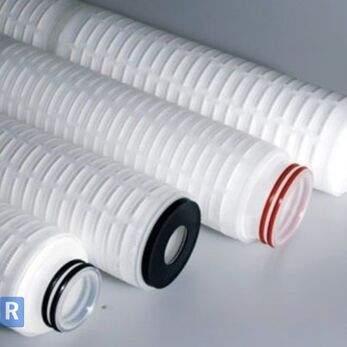
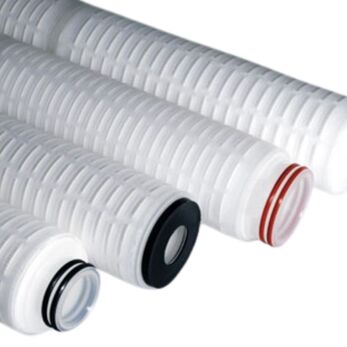
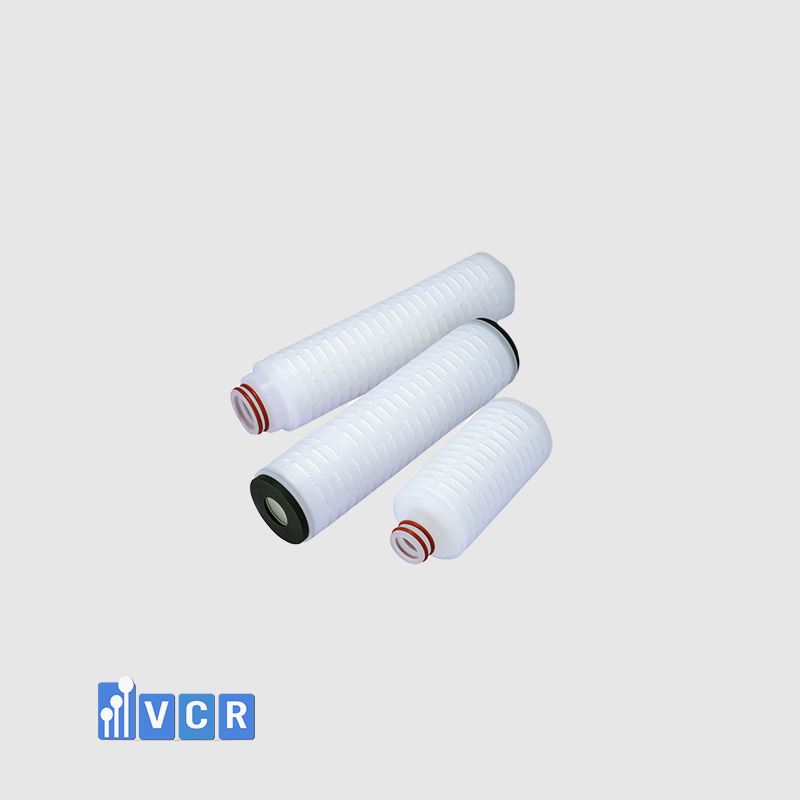
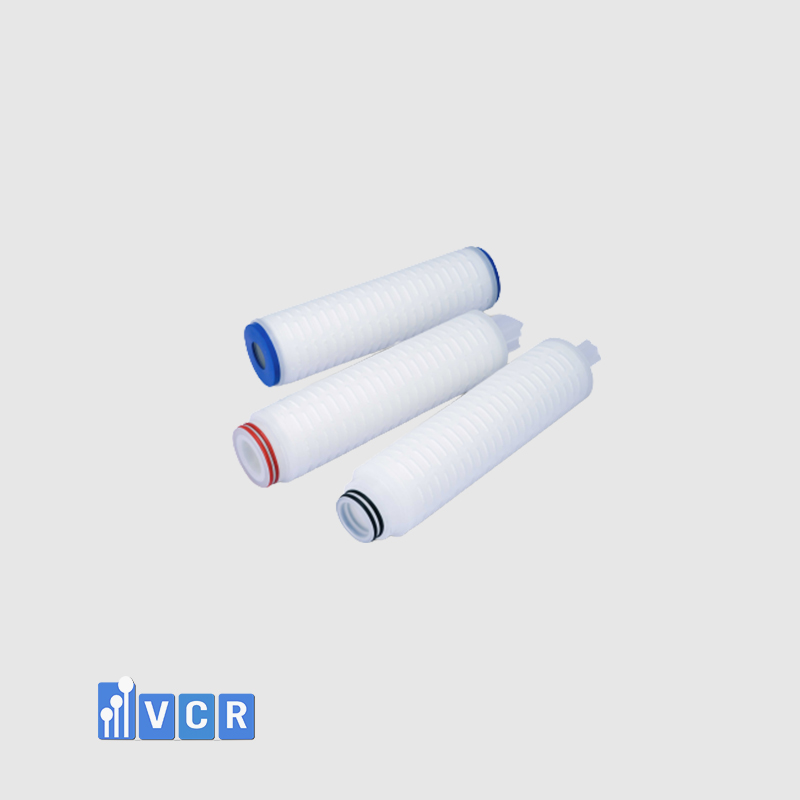
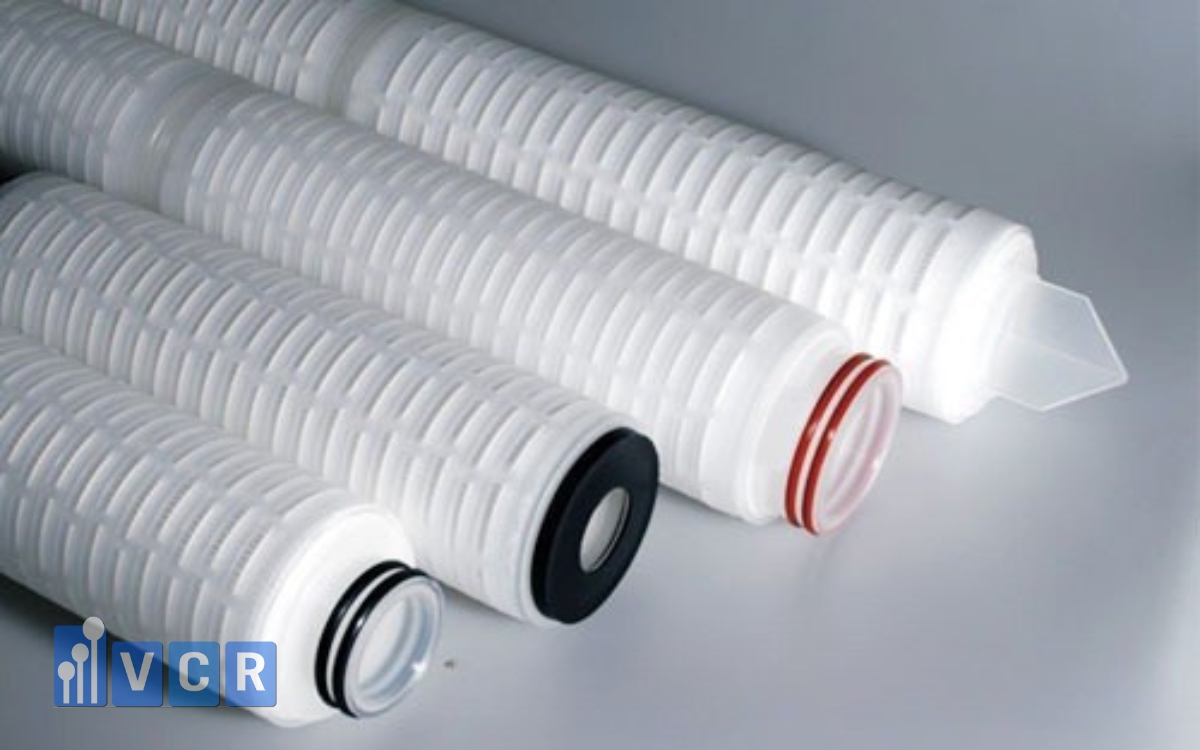
A cartridge filter is a cylindrical filtration element installed inside an independent filter housing.
The cartridge contains filter media, support layers, a central core, an external cage and end connections. However, it does not normally include the pressure-retaining housing required to contain the process liquid.
The cartridge may use a double-open-end configuration, flat gaskets, O-ring adapters or sanitary-style connections such as 222 or 226 adapters.
Standard cartridge lengths commonly include 10, 20, 30 and 40 inches. Multiple cartridges can be installed inside one housing to provide the required filtration area and flow capacity.
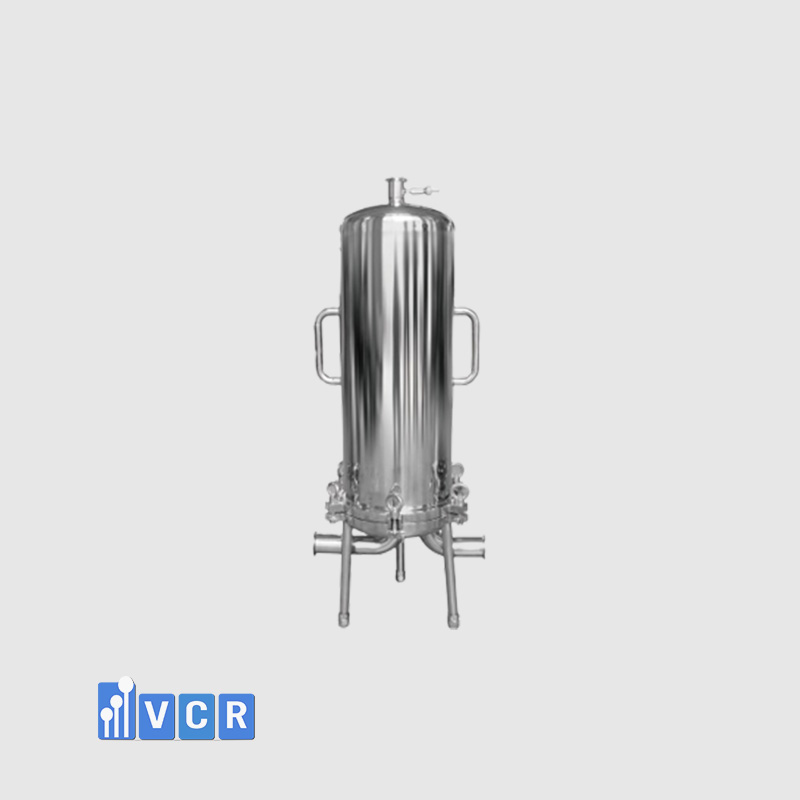
Cartridge housings may be manufactured from stainless steel, engineering plastic or another material compatible with the process. In pharmaceutical, biotechnology, food and beverage applications, stainless-steel sanitary housings are widely used because they can be cleaned, sterilized and reused.
Capsule Filter vs Cartridge Filter: Quick Comparison
| Comparison factor | Capsule filter | Cartridge filter |
|---|---|---|
| Basic construction | Filter media permanently enclosed in a disposable housing | Replaceable element installed in a separate housing |
| External housing | Integrated into the product | Purchased and maintained separately |
| Typical use | Laboratory, pilot, small batch and point-of-use filtration | Industrial production and higher-volume processing |
| Installation | Simple connection to tubing or process line | Requires housing opening, cartridge installation and sealing |
| Flow capacity | Usually low to medium | Medium to very high |
| Filtration area | Generally limited by capsule size | Can be increased with longer or multiple cartridges |
| Hold-up volume | Usually low | Usually higher because of the housing volume |
| Cleaning requirement | Usually no housing cleaning after disposal | Housing must be cleaned and inspected |
| Cross-contamination risk | Lower when used as a closed single-use unit | Depends on cleaning and assembly controls |
| Initial equipment cost | Low | Higher because a reusable housing is required |
| Cost per filter change | Entire capsule is replaced | Only the cartridge is normally replaced |
| Scalability | Suitable for development and small production | Better for large-scale and continuous systems |
| Waste volume | More plastic waste per filtration element | Less disposable housing material |
| Sterilization | May be supplied pre-sterilized or sterilizable | Cartridge and housing may require separate sterilization |
| Operator handling | Minimal contact with contaminated filter media | Operator may contact the used cartridge during change-out |
Difference in Housing Design
The housing design is the clearest distinction between the two filter formats.
In a capsule filter, the plastic outer shell is part of the disposable filtration unit. The internal filter media cannot normally be removed or replaced independently.
In a cartridge system, the pressure housing and the filter element are separate components. The housing is reused, while the cartridge is replaced according to differential pressure, batch requirements or process-validation limits.
This difference affects installation, maintenance, contamination control and lifecycle cost.
A capsule can be connected directly to flexible tubing or a small process line. A cartridge must be installed correctly inside a compatible housing, with particular attention to the adapter, O-rings, gasket and sealing surface.
Difference in Flow Capacity
Cartridge filter systems usually provide higher flow capacity than capsule filters.
A standard cartridge can contain a large pleated filtration area. Longer cartridges and multi-round housings allow many cartridges to operate in parallel, making the format suitable for large industrial flow rates.
Capsule filters are generally compact. Their flow capacity is limited by the size of the enclosed media pack, the diameter of the connections and the pressure capability of the plastic housing.
Large capsule filters can support significant flow for selected processes, but conventional cartridge systems remain more practical for continuous production and high-volume filtration.
The correct comparison must be made using the manufacturer’s flow-versus-pressure-drop data for the actual liquid viscosity.
Difference in Filtration Area
Both capsule and cartridge filters may use pleated media, but cartridge systems are easier to scale to a large total filtration area.
A cartridge housing can accept longer cartridges or several cartridges installed in parallel. Increasing the number of cartridges reduces the flow passing through each unit area of media.
Capsule filters are available in different sizes, but the filtration area remains fixed within each capsule format.
For small batches, a limited filtration area can be beneficial because it reduces product hold-up and unnecessary filter cost. For large batches, insufficient area may cause rapid pressure-drop growth and short service life.
Difference in Hold-Up Volume
Hold-up volume is the amount of liquid remaining inside a filtration assembly after processing or drainage.
Capsule filters generally have a low internal hold-up volume because the media and housing are integrated into a compact assembly.
Low hold-up is valuable when filtering expensive pharmaceutical products, biological materials, laboratory reagents or small batches. Reducing retained liquid can improve product recovery.
A conventional cartridge housing normally contains more internal free volume. Liquid may remain around the cartridge, inside the housing sump and within associated pipework.
The actual hold-up depends on the capsule design, cartridge length, housing dimensions, flow direction and drainage arrangement.
Difference in Installation
Capsule filters are easier and faster to install.
The operator connects the inlet and outlet, confirms the flow direction, vents the unit when necessary and begins the filtration procedure. No separate cartridge housing needs to be opened.
A cartridge filter requires more installation steps. The housing must be opened, cleaned or inspected, and fitted with the correct cartridge. The operator must verify that the O-rings or gaskets are properly seated before closing the housing.
Incorrect cartridge installation can cause bypass leakage, damage to the cartridge adapter or loss of filter integrity.
Capsule filters therefore reduce assembly complexity, especially in systems that use flexible tubing and disposable process components.
Difference in Contamination Risk
Capsule filters support a more closed filtration process.
Because the filter media is permanently contained within the capsule, the operator does not normally touch the internal element during installation or disposal. This can reduce the risk of introducing contamination into the process.
After use, the inlet and outlet may be clamped or capped before the capsule is removed.
In a cartridge system, the housing must be opened during filter replacement. The used cartridge is removed manually, creating a greater potential for operator exposure, environmental contamination or cross-contamination if the maintenance procedure is not properly controlled.
A well-designed cartridge process can still provide reliable contamination control, but it requires validated cleaning, handling and assembly procedures.
Difference in Cleaning Requirements
Disposable capsule filters usually eliminate the need to clean a separate filter housing.
The entire wetted filtration unit is removed after use. This can reduce cleaning time, water consumption, cleaning chemicals and the need to validate housing-cleaning procedures.
A reusable cartridge housing must normally be drained, opened, cleaned and inspected between uses or batches. In hygienic applications, it may also need sanitization or sterilization.
The cartridge itself may be disposable or reusable depending on the product design. However, many membrane cartridges used for critical filtration are replaced according to a validated lifecycle rather than cleaned indefinitely.
Capsule systems are especially attractive when cleaning validation is difficult or when frequent product changeovers create a high risk of cross-contamination.
Difference in Sterilization
Capsule filters may be supplied non-sterile, pre-sterilized or compatible with selected sterilization procedures.
Some capsules can be autoclaved or gamma irradiated, while others are intended for one-time use without reprocessing. Sterilization limits depend on the housing polymer, filter media, connections and assembly method.
Cartridge filters may be sterilized inside a compatible housing using steam-in-place, autoclaving or another validated method. Certain cartridges can withstand multiple sterilization cycles, but the allowable number of cycles is product-specific.
For sterile applications, users must verify the complete system rather than assuming that a membrane pore rating alone provides sterility.
Important factors include bacterial retention validation, integrity testing, sterilization compatibility, installation controls and post-use handling.
Difference in Integrity Testing
Both capsule and cartridge filters may be integrity tested when they contain membrane media designed for critical filtration.
Common integrity-test methods include bubble-point testing, diffusion testing, pressure-hold testing and water-intrusion testing.
Capsules can simplify testing because the media, housing and connections form a complete unit. However, the small internal volume and connection arrangement may require specific test parameters.
Cartridge systems may use automated integrity testing through the stainless-steel housing. The test procedure must account for cartridge type, membrane material, number of cartridges, housing volume and wetting fluid.
Not every sediment or depth filter requires an integrity test. Integrity testing is most relevant for critical membrane filtration where filter performance must be demonstrated before or after use.
Difference in Pressure Capability
Cartridge systems with stainless-steel housings generally tolerate higher process pressures than disposable plastic capsules.
The cartridge itself must still remain within its allowable differential-pressure limit, but the metal housing provides a robust pressure boundary.
Capsule filters have maximum operating-pressure limits determined by the plastic shell, connection design and temperature. Their allowable pressure may decrease at elevated temperature.
The user must distinguish between system pressure and differential pressure across the filter media. A capsule or cartridge may be exposed to moderate line pressure while experiencing a lower differential pressure through the filter.
Exceeding the specified limit can deform the media, damage the housing or cause leakage.
Difference in Cost
Capsule filters usually have a lower initial equipment cost because no separate housing is required.
This makes them economical for laboratories, research facilities, clinical production, pilot plants and occasional filtration tasks.
However, the entire capsule, including its plastic housing, must be replaced after use. For continuous production and large liquid volumes, the replacement cost can become significant.
Cartridge filter systems require a greater initial investment in the housing, valves, gauges and installation. Once the system is established, only the cartridge and seals normally require replacement.
For high-volume filtration, cartridges often provide a lower cost per liter of processed liquid.
Lifecycle cost should include equipment investment, filter consumption, cleaning labor, cleaning chemicals, water use, production downtime, sterilization, disposal and product loss due to hold-up.
Difference in Waste Generation
Capsule filters generate more disposable material because the filter element and outer housing are discarded together.
This supports closed handling and operational convenience but increases the amount of plastic waste.
Cartridge systems retain the reusable housing. Only the cartridge and certain sealing components are disposed of during routine replacement.
The environmental comparison depends on the number of batches, cleaning requirements, water consumption, chemical use and energy needed to operate each system.
A reusable cartridge housing may reduce solid waste, while a single-use capsule can reduce cleaning utilities and wastewater.
Typical Applications of Capsule Filters
Capsule filters are widely used for:
-
Laboratory liquid filtration
-
Research and process development
-
Pilot-scale production
-
Small pharmaceutical batches
-
Buffer and media filtration
-
Bioprocessing
-
Vaccine and biological production
-
Point-of-use water filtration
-
Small-volume sterile filtration
-
Vent and gas filtration
-
Sampling systems
-
Disposable filling lines
-
Single-use process assemblies
They are especially suitable when the process values low hold-up volume, simple installation, closed handling and reduced cleaning validation.
Typical Applications of Cartridge Filters
Cartridge filters are widely used for:
-
Pharmaceutical production
-
Food and beverage processing
-
Purified-water systems
-
Process-water filtration
-
Chemical manufacturing
-
Cosmetics production
-
Electronics and semiconductor processing
-
Paints, coatings and inks
-
Reverse-osmosis prefiltration
-
High-purity chemical filtration
-
Large-volume sterile filtration
-
Continuous industrial processes
They are especially suitable when the process requires higher flow, larger filtration area, long operating periods or a low filtration cost per unit of liquid.
Can Capsule and Cartridge Filters Use the Same Media?
Yes. Capsule and cartridge filters can use similar or identical filtration media.
Both formats may be manufactured with:
-
Polypropylene
-
Polyethersulfone
-
Polytetrafluoroethylene
-
Polyvinylidene fluoride
-
Nylon
-
Glass fiber
-
Cellulose-based media
-
Multilayer depth media
A PES membrane can be installed inside a capsule or manufactured as a conventional cartridge. The difference in format does not automatically change the membrane’s fundamental chemical characteristics.
However, total filtration performance also depends on the effective area, pleat design, support structure, housing, connection, flow path and manufacturing quality.
Two filters with the same membrane material and nominal pore rating may therefore have different flow capacity, pressure drop and service life.
Capsule Filter vs Cartridge Filter for Sterile Filtration
For small-batch sterile filtration, a capsule filter often provides the simpler solution.
It can be integrated into a closed disposable flow path, supplied pre-sterilized and disposed of without opening a filter housing.
For large-volume sterile filtration, cartridge filters installed in sanitary stainless-steel housings may provide greater capacity and lower operating cost. Multiple cartridges can be installed in parallel to process high flow rates.
The correct option depends on batch volume, product value, required filtration area, sterilization strategy, integrity-testing requirements, allowable hold-up and facility design.
Both formats must use a validated sterilizing-grade membrane when microbial retention is required.
Capsule Filter vs Cartridge Filter for Water Treatment
Cartridge filters are more common in general water-treatment systems because they provide higher capacity and can be installed in standard reusable housings.
They are used for sediment removal, membrane protection, fine particle filtration and process-water treatment.
Capsule filters may be used for point-of-use purified water, laboratory water, equipment protection and low-volume applications.
For routine high-flow water treatment, a cartridge system is usually more economical. For small systems that prioritize hygiene, low hold-up and simple replacement, a capsule may be more practical.
How to Choose Between a Capsule Filter and a Cartridge Filter
The selection should begin with the process scale and filtration objective.
A capsule filter is generally the better choice when:
-
Batch volume is small
-
Low product hold-up is important
-
A closed disposable flow path is required
-
Installation must be simple
-
Cleaning validation should be minimized
-
Product changeovers are frequent
-
The process is laboratory or pilot scale
-
Operator exposure must be reduced
A cartridge filter is generally the better choice when:
-
Flow rate is high
-
Batch volume is large
-
The system operates continuously
-
Multiple filter elements are required
-
A reusable housing is acceptable
-
Lower cost per processed volume is important
-
The facility has cleaning and sterilization capability
-
The filtration system must be scaled to industrial production
The final choice must also consider filter media, retention rating, chemical compatibility, pressure drop, temperature, connection type and required documentation.
Common Selection Mistakes
One common mistake is assuming that a capsule filter is always a small cartridge inside a plastic housing and therefore provides identical performance to a standard cartridge.
The media may be similar, but the effective area, flow path, connection diameter and operating limits can be different.
Another mistake is comparing products only by pore rating. A 0.2-micron capsule and a 0.2-micron cartridge are not necessarily equivalent unless they have comparable validated retention performance.
Some users select a capsule for a large batch because the initial installation is simpler. The limited media area may then cause rapid blockage and frequent replacement.
Others install an oversized cartridge housing for a very small batch, creating unnecessary product hold-up and cleaning requirements.
The format should always be selected according to the complete process rather than the filter size alone.
Frequently Asked Questions
what is the main difference between a capsule filter and a cartridge filter?
A capsule filter combines the filter element and housing in one disposable unit. A cartridge filter is a replaceable element that must be installed inside a separate reusable housing.
is a capsule filter disposable?
Most capsule filters are designed as disposable units. Some may tolerate sterilization or limited reuse, but reuse must be approved by the manufacturer and process-validation procedure.
does a cartridge filter need a housing?
Yes. A conventional cartridge does not provide its own pressure-retaining enclosure and must be installed inside a compatible housing.
which filter has a higher flow rate?
Cartridge filter systems generally support higher flow rates because they can use longer cartridges and multiple elements in parallel.
which filter has lower hold-up volume?
Capsule filters normally have lower hold-up volume because the media is enclosed within a compact integrated housing.
which is better for small-batch filtration?
A capsule filter is usually better for small batches, laboratory processes, pilot production and applications where low hold-up and simple installation are important.
which is better for industrial production?
A cartridge system is generally more suitable for continuous production, high flow and large batch volumes.
can capsule filters be used for sterile filtration?
Yes, provided the capsule contains a validated sterilizing-grade membrane and is used according to an approved sterilization, installation and integrity-testing procedure.
can cartridge filters be used for sterile filtration?
Yes. Sterilizing-grade membrane cartridges are widely used in pharmaceutical, biotechnology, food and beverage production.
are capsule filters more expensive than cartridge filters?
A capsule usually has a lower initial system cost because no separate housing is required. For repeated high-volume use, cartridges may provide a lower cost per liter because the housing is reused.
can the same membrane be used in both formats?
Yes. Materials such as PES, PTFE, PVDF, nylon and polypropylene can be used in both capsule and cartridge formats.
which format creates more waste?
Capsules normally create more disposable plastic waste because the housing and filter media are discarded together. Cartridge systems reuse the external housing.
Conclusion
The difference between a capsule filter and a cartridge filter is primarily their construction and installation format.
A capsule filter is a complete disposable filtration assembly with integrated media, housing and process connections. It provides simple installation, low hold-up volume, closed handling and reduced cleaning requirements.
A cartridge filter is a replaceable element installed inside a separate reusable housing. It provides greater scalability, higher flow capacity and lower filtration cost for continuous or large-volume industrial processes.
Neither format is universally better.
Capsule filters are generally more appropriate for laboratories, pilot plants, small batches, single-use systems and processes requiring minimal cleaning validation. Cartridge filters are better suited to industrial production, high-flow filtration and long-term reusable systems.
The correct choice should be based on batch volume, flow rate, filtration area, hold-up, contamination risk, sterilization strategy, lifecycle cost and the required retention performance.